Imagine a situation where a person is arrested after a robbery in a local market. News headlines quickly announce that the person has been “charged” with robbery.
A few months later, another report says the same person was “convicted” in court. Many people assume these two words mean the same thing, but they are very different in the legal world.
Understanding the difference between charged and convicted is important because these terms affect a person’s reputation, rights, and future.
The difference between charged and convicted often confuses students, journalists, and even professionals.
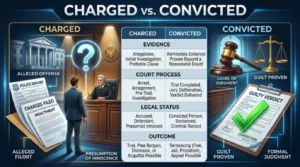
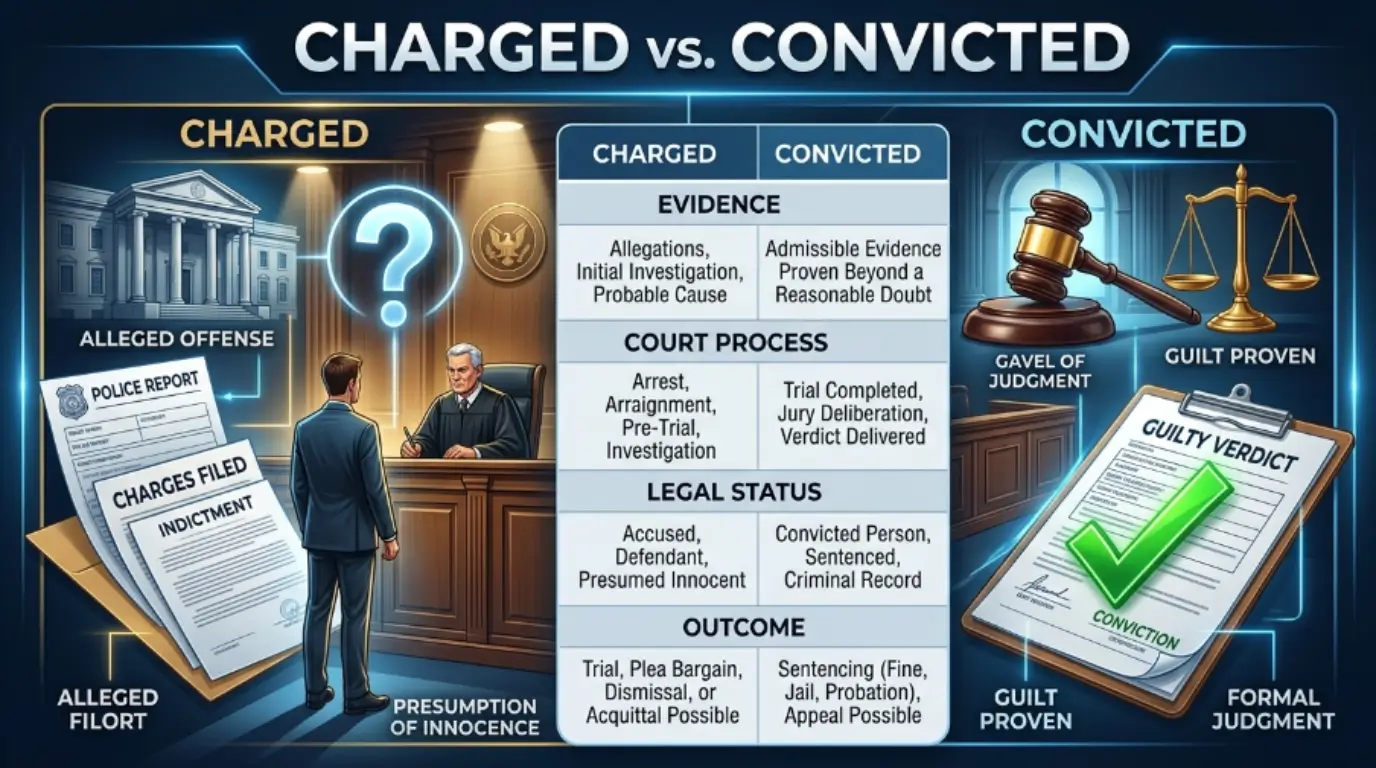
Being charged only means a formal accusation has been made, while being convicted means the court has officially declared someone guilty.
Learning the difference between charged and convicted helps people understand legal news correctly and prevents misunderstandings.
In society, knowing the difference between charged and convicted also supports fairness and justice.
Pronunciation of Charged and Convicted
Charged
- US Pronunciation: /tʃɑrdʒd/
- UK Pronunciation: /tʃɑːdʒd/
Convicted
- US Pronunciation: /kənˈvɪk.tɪd/
- UK Pronunciation: /kənˈvɪk.tɪd/
Understanding these pronunciations makes it easier to recognize the words in legal discussions, news reports, and courtroom dramas. Now, let us move deeper into the legal and social meaning behind these important terms.
Difference Between Charged and Convicted
1. Meaning
Charged
A person is charged when authorities formally accuse them of committing a crime.
Examples
- The police charged Ahmed with theft after the investigation.
- Maria was charged with speeding last week.
Convicted
A person is convicted when the court finds them guilty after a trial or legal process.
Examples
- Ahmed was convicted of theft after evidence was presented.
- The driver was convicted of reckless driving.
2. Stage in Legal Process
Charged
Charging happens at the beginning of a legal case.
Examples
- The suspect was charged immediately after arrest.
- The company owner was charged before the trial began.
Convicted
Conviction happens near the end of the legal process.
Examples
- He was convicted after six months of hearings.
- The judge convicted the accused based on strong evidence.
3. Proof of Guilt
Charged
Being charged does not prove guilt.
Examples
- Sarah was charged, but she denied the accusations.
- A charged person can still be innocent.
Convicted
Being convicted means guilt has been legally proven.
Examples
- The convicted criminal received a prison sentence.
- He was convicted because witnesses confirmed the crime.
4. Decision Maker
Charged
Police officers or prosecutors decide to charge someone.
Examples
- Prosecutors charged the businessman with fraud.
- The state charged the suspect after reviewing reports.
Convicted
A judge or jury decides conviction.
Examples
- The jury convicted the accused after long discussions.
- The judge convicted him under criminal law.
5. Legal Status
Charged
A charged person is still legally innocent.
Examples
- The charged student continued attending classes.
- She was charged but not punished yet.
Convicted
A convicted person is legally guilty.
Examples
- The convicted man lost certain civil rights.
- Convicted offenders may face restrictions.
6. Punishment
Charged
No punishment is guaranteed after charges.
Examples
- The charges were dropped before court.
- He was charged but later released.
Convicted
Punishment usually follows conviction.
Examples
- The convicted thief received a fine.
- She was convicted and sentenced to prison.
7. Reputation Impact
Charged
Charges may damage reputation temporarily.
Examples
- The politician faced criticism after being charged.
- The athlete lost sponsors after charges were announced.
Convicted
Conviction causes stronger social consequences.
Examples
- The convicted officer lost his job permanently.
- Conviction harmed the businessman’s public image.
8. Court Evidence
Charged
Evidence may still be incomplete.
Examples
- He was charged based on early findings.
- Police charged the suspect while gathering proof.
Convicted
Conviction requires strong evidence.
Examples
- DNA evidence helped convict the criminal.
- Witness testimony led to conviction.
9. Possibility of Freedom
Charged
Charged individuals may get bail.
Examples
- The charged suspect returned home on bail.
- She was charged but allowed temporary freedom.
Convicted
Convicted people may go to prison immediately.
Examples
- The convicted man was taken to jail.
- Convicted offenders often lose freedom.
10. Future Opportunities
Charged
Charges alone may not permanently affect opportunities.
Examples
- He found work after charges were dismissed.
- The charged employee later rebuilt her career.
Convicted
Conviction can affect jobs and travel opportunities.
Examples
- Convicted individuals may struggle to get visas.
- Employers often check conviction records.
Nature and Behaviour of Both
Charged
The word “charged” carries a temporary and uncertain nature. It represents accusation rather than final judgment. Its behavior in language is cautious because it does not confirm guilt.
Convicted
The word “convicted” has a final and serious nature. It represents legal certainty and punishment. It often carries emotional and social weight.
Why People Are Confused About Their Use?
People often confuse these words because media reports use them in similar situations.
News headlines may quickly mention arrests and accusations, causing readers to assume guilt. Another reason is that both words are connected to crime and courts.
However, the key distinction is that “charged” means accused, while “convicted” means proven guilty.
Difference and Similarity Table
| Aspect | Charged | Convicted | Similarity |
| Meaning | Formal accusation | Proven guilty | Both are legal terms |
| Stage | Beginning of case | End of case | Related to criminal law |
| Guilt | Not proven | Proven | Involve court procedures |
| Decision | Prosecutor/police | Judge/jury | Affect reputation |
| Punishment | Not certain | Usually certain | May appear in legal records |
| Freedom | Bail possible | Jail possible | Connected to justice system |
| Evidence | Preliminary | Strong evidence required | Depend on investigations |
| Social Effect | Temporary | Long-term | Public attention possible |
Which Is Better in What Situation?
Charged
From a legal perspective, being charged is better than being convicted because a charged person still has the right to defend themselves in court.
Charges can be removed if evidence is weak. Society should also remember that charged individuals are presumed innocent until proven guilty. Therefore, a charge does not automatically destroy a person’s future.
Convicted
Conviction is not considered “better” for the accused person, but it is important when justice is served correctly. A conviction can protect society by punishing criminals and discouraging harmful behavior. In legal systems, convictions help maintain law, order, and accountability.
How the Keywords Are Used in Metaphors and Similes
Charged
- “The atmosphere was charged with tension.”
- “Her speech was charged like a storm cloud.”
Convicted
- “He spoke with the conviction of a true leader.”
- “She stood convicted by her own conscience.”
Connotative Meaning of Both Keywords
Charged
- Connotation: Neutral to negative
- Example: “The businessman was charged with corruption.”
Convicted
- Connotation: Strongly negative in legal use, positive in emotional use
- Examples:
- Negative: “The convicted criminal entered prison.”
- Positive: “She was convicted in her beliefs.”
Idioms or Proverbs Related to the Words
1. “In the dock”
Meaning: Being accused in court.
Example:
“The politician found himself in the dock after the scandal.”
2. “Caught red-handed”
Meaning: Caught while committing a crime.
Example:
“The thief was caught red-handed by security guards.”
3. “Justice delayed is justice denied”
Meaning: Late justice is unfair justice.
Example:
“The victim’s family believed justice delayed is justice denied.”
Works in Literature Related to the Keywords
- Crime and Punishment — Novel, Fyodor Dostoevsky, 1866
- To Kill a Mockingbird — Novel, Harper Lee, 1960
- The Trial — Novel, Franz Kafka, 1925
- Anatomy of a Murder — Legal Fiction, Robert Traver, 1958
Movies Related to the Keywords
- The Convicted — Released in 2015, USA
- Conviction — Released in 2010, USA
- The Charge of the Light Brigade — Released in 1968, UK
- Primal Fear — Released in 1996, USA
Frequently Asked Questions
Can a person be charged and still be innocent?
Yes. A charge is only an accusation, not proof of guilt.
Does conviction always mean prison?
No. Some convictions result in fines, probation, or community service.
Can charges be dropped?
Yes. Prosecutors may drop charges if evidence is weak.
Can a convicted person appeal?
Yes. Convicted individuals can request a higher court to review the case.
Why is the difference between charged and convicted important?
It protects fairness and prevents people from assuming guilt too early.
How Both Are Useful for Surroundings
The concepts of being charged and convicted help maintain social order and justice.
Charging allows authorities to investigate crimes formally, while conviction ensures that proven offenders are held accountable.
Together, they create balance between protecting innocent people and punishing guilty individuals. These legal processes also increase public trust in courts and law enforcement.
Final Words for Both
“Charged” reminds society that accusations are not final truths. “Convicted” represents the legal conclusion of guilt after proper examination.
Both words are essential in legal communication and should be used carefully to avoid misunderstanding.
Conclusion
Understanding the difference between charged and convicted is necessary for students, professionals, journalists, and ordinary citizens.
Although both terms belong to the legal system, they represent very different stages of justice.
A charged person is only accused of a crime, while a convicted person has been found guilty by a court. Confusing these terms can harm reputations and spread misinformation.
In modern society, where legal news spreads quickly through media, accurate understanding is more important than ever.
Learning the difference between charged and convicted helps people think critically, respect the legal process, and avoid unfair judgments.
Ultimately, these terms remind us that justice depends on evidence, fairness, and careful legal procedures.