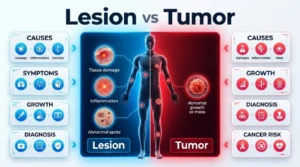
In everyday medical conversations, the terms lesion and tumor often create confusion, especially when people hear doctors using them in reports or diagnoses.
A lesion and a tumor may sound similar, but they are not the same in meaning or medical impact.
For instance, a patient visiting a clinic after noticing a skin abnormality might be told it is a lesion, while another might hear the word tumor during an imaging scan discussion.
Understanding the difference between lesion and tumor is essential because the difference between lesion and tumor affects diagnosis, treatment, and emotional response.
Doctors use both terms carefully, and the difference between lesion and tumor helps distinguish simple tissue damage from abnormal growth.
In medical science, the difference between lesion and tumor is a key concept for accurate interpretation.
Lesion (US): /ˈliːʒən/
Lesion (UK): /ˈliːʒən/
Tumor (US): /ˈtuːmər/
Tumor (UK): /ˈtjuːmə/
While both terms relate to abnormal body changes, understanding their real meaning helps avoid unnecessary fear and misinterpretation. Let’s explore their deeper differences.
Key Difference Between Lesion and Tumor
- A lesion refers to any abnormal change in body tissue.
- A tumor specifically refers to abnormal cell growth or mass formation.
Why Their Difference Matters for Learners and Experts
Understanding the difference between lesion and tumor is crucial for students, medical professionals, and researchers because it directly impacts diagnosis accuracy and treatment decisions.
In society, misinterpreting these terms can cause unnecessary panic or delay proper treatment.
For example, not all lesions are dangerous, but tumors may sometimes require urgent attention. In hospitals, accurate terminology improves communication between doctors and patients.
For learners, it builds a strong foundation in medical science, while for experts, it ensures precision in reporting and research.
Ultimately, knowing the distinction supports better healthcare awareness and reduces misinformation in society.
Difference Between Lesion and Tumor
1. Definition
- Lesion: Any abnormal tissue change.
- Example: Skin rash, mouth ulcer
- Tumor: Abnormal cell growth forming a mass.
- Example: Brain tumor, breast tumor
2. Nature
- Lesion: Can be injury, infection, or inflammation.
- Example: Burn wound, acne spot
- Tumor: Usually uncontrolled cell growth.
- Example: Benign lipoma, malignant carcinoma
3. Formation
- Lesion: May form suddenly due to damage.
- Example: Cut on skin, bruise
- Tumor: Develops gradually over time.
- Example: Slow-growing lump, cancer mass
4. Severity
- Lesion: Can be mild or harmless.
- Example: Minor skin irritation
- Tumor: Can be benign or life-threatening.
- Example: Malignant tumor, metastatic cancer
5. Medical Scope
- Lesion: Broad medical term.
- Example: Brain lesion, liver lesion
- Tumor: Specific growth-related term.
- Example: Tumor in lung, kidney tumor
6. Cause
- Lesion: Caused by injury, infection, or disease.
- Example: Bacterial infection lesion
- Tumor: Caused by genetic mutation or abnormal cell division.
- Example: Cancerous tumor formation
7. Detection
- Lesion: Found through physical exam or imaging.
- Example: MRI showing brain lesion
- Tumor: Detected via scans and biopsies.
- Example: CT scan showing tumor mass
8. Treatment
- Lesion: Treated based on cause.
- Example: Antibiotics for infection lesion
- Tumor: May need surgery, chemotherapy, or radiation.
- Example: Tumor removal surgery
9. Growth Pattern
- Lesion: May not grow.
- Example: Scar lesion remains stable
- Tumor: Often grows progressively.
- Example: Expanding tumor in organ
10. Outcome
- Lesion: Often heals or stabilizes.
- Example: Healed skin lesion
- Tumor: May persist or spread if untreated.
- Example: Metastatic tumor progression
Nature and Behaviour
A lesion behaves as a general term for any tissue damage or abnormality. It may remain stable, heal naturally, or require simple treatment.
On the other hand, a tumor behaves more aggressively in some cases because it involves abnormal cell growth. Tumors can expand, invade nearby tissues, and sometimes spread to other parts of the body, especially in malignant cases.
While lesions are often symptoms or signs of an underlying condition, tumors represent a specific biological process of uncontrolled cell multiplication.
Why People Are Confused
People often confuse lesion and tumor because both appear in medical reports and imaging results. Doctors may describe both using similar diagnostic tools like MRI or CT scans.
Some tumors are also called lesions in medical terminology, which increases confusion. Lack of medical knowledge and fear of serious illness also contribute to misunderstanding.
Difference and Similarity Between Lesion and Tumor
| Feature | Lesion | Tumor |
| Meaning | Any tissue abnormality | Abnormal cell growth |
| Nature | Broad term | Specific growth |
| Severity | Mild to severe | Can be benign or malignant |
| Growth | Not always progressive | Often progressive |
| Cause | Injury, infection, disease | Genetic mutation |
Similarity: Both indicate abnormal body conditions and may require medical evaluation.
Which is Better in What Situation?
A lesion is more general and often less alarming, making it “better” in situations where minor injuries or infections are involved, such as skin cuts or ulcers. It helps doctors describe a wide range of conditions without assuming severity.
A tumor, however, is more important in situations where abnormal cell growth is suspected. It is “better” as a diagnostic term when identifying serious conditions like cancer or benign growths.
Both terms are essential in medicine, but their usefulness depends entirely on the medical context and level of severity.
Metaphors and Similes
- Lesion is sometimes used metaphorically as a “scar on society,” meaning damage or harm.
- Example: “Corruption is a lesion on the nation’s progress.”
- Tumor is used as a metaphor for something growing uncontrollably.
- Example: “Hatred grows like a tumor in society if ignored.”
Connotative Meaning
- Lesion: Neutral to slightly negative (medical abnormality or damage)
- Example: “Doctors detected a lesion, but it was harmless.”
- Tumor: Often negative (associated with serious illness, though not always cancerous)
- Example: “The tumor was benign and removed safely.”
Idioms or Proverbs
- “Root out the lesion before it spreads” (used metaphorically for stopping problems early).
- Example: Leaders must root out corruption before it spreads.
- “Like a tumor in silence” (used for hidden growth of problems).
- Example: Ignorance grows like a tumor in silence.
Works in Literature
- The Tumor – F. Paul Wilson (Medical thriller, 2014)
- Cancer Ward (translated themes involving tumor conditions) – Aleksandr Solzhenitsyn (Novel, 1968)
- Medical case studies in The Lancet journal (Medical literature, ongoing publications)
Movie References
- The Fault in Our Stars (USA, 2014) – explores cancer and tumors
- My Sister’s Keeper (USA, 2009) – includes medical tumor themes
- Dying Young (USA, 1991) – focuses on tumor-related illness
Frequently Asked Questions
Is every lesion a tumor?
No, a lesion is a broader term and not all lesions are tumors.
Can a tumor be called a lesion?
Yes, medically tumors are considered a type of lesion.
Are lesions dangerous?
Not always, many lesions are harmless or temporary.
Are all tumors cancerous?
No, tumors can be benign or malignant.
How are they diagnosed?
Through imaging tests, biopsies, and medical examination.
How Both Are Useful for Surroundings
Lesions and tumors both help doctors understand what is happening inside the human body. Lesions indicate injuries or infections that need care, while tumors help identify abnormal growth that may require serious treatment.
Together, they support early diagnosis, better treatment planning, and improved healthcare awareness in society. Without these terms, medical communication would be less precise and more confusing.
Conclusion
The difference between lesion and tumor lies in their meaning, behavior, and medical importance.
A lesion can represent any abnormal tissue condition, from mild irritation to serious disease signs, while a tumor specifically refers to abnormal and often progressive cell growth.
Although they sometimes overlap in medical usage, they are not interchangeable. Understanding this distinction is essential for students, patients, and healthcare professionals alike.
It improves diagnosis accuracy, supports better treatment decisions, and reduces confusion in medical communication. Ultimately, awareness of these terms strengthens overall health literacy in society.