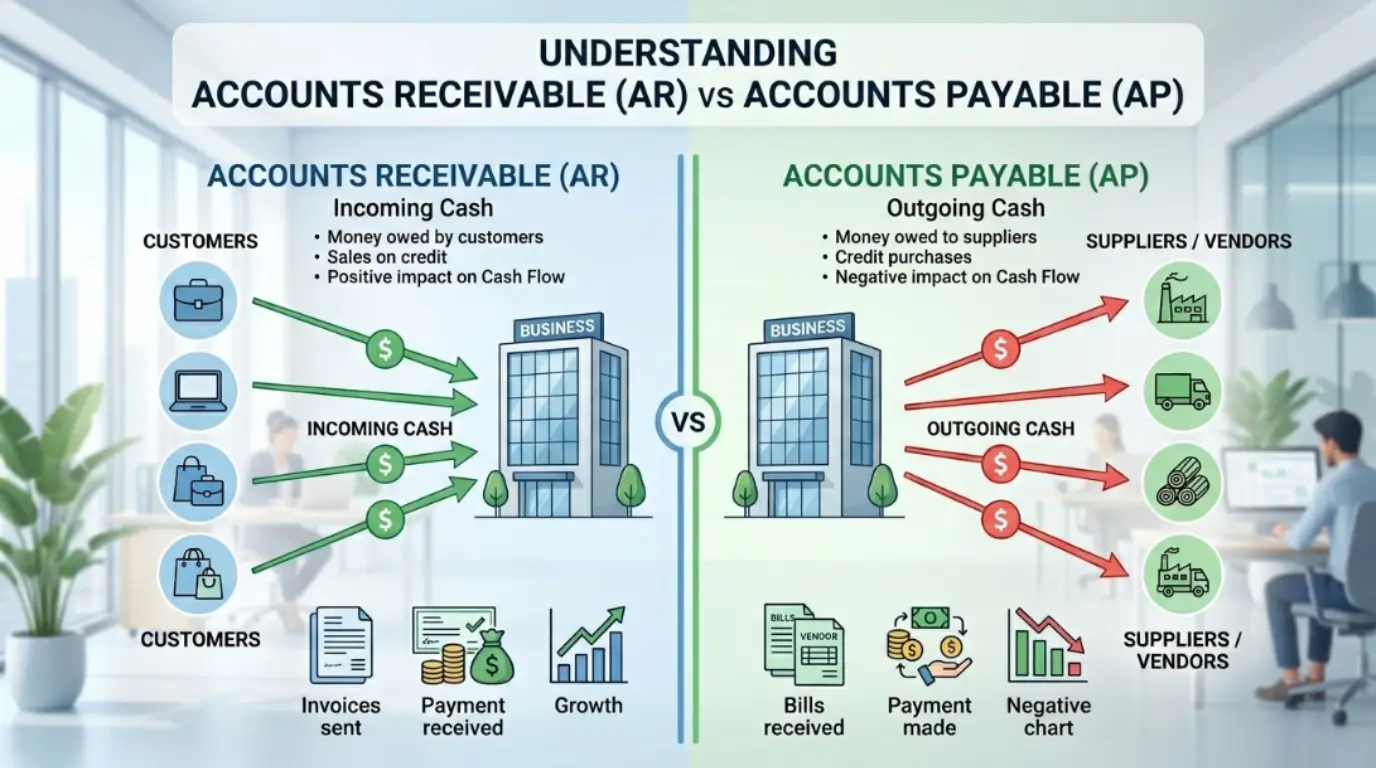
In the world of business, two terms quietly control the flow of money—Accounts Receivable (AR) and Accounts Payable (AP). Imagine running a small shop: you sell products to a customer who promises to pay later—that’s AR.
On the other hand, you purchase inventory from a supplier and agree to pay them later—that’s AP. This simple real-life situation perfectly explains the difference between AR and AP.
Understanding the difference between AR and AP is essential because it directly impacts a company’s cash flow and financial health.
Whether you are a student, entrepreneur, or finance expert, knowing the difference between AR and AP helps you manage money more effectively.
The difference between AR and AP is not just about accounting—it reflects how businesses survive and grow in the real world.
Key Difference Between AR and AP
The main difference between AR and AP lies in cash movement. AR represents money coming into a business, while AP represents money going out. AR is an asset, whereas AP is a liability.
Why Is Their Difference Important?
Understanding the difference between AR and AP is crucial for both learners and professionals. For students, it builds a strong accounting foundation.
For businesses, it ensures proper cash flow management, helps avoid financial crises, and improves decision-making.
In society, efficient management of AR and AP supports economic stability by ensuring businesses pay debts on time and collect revenue efficiently.
Pronunciation (US & UK)
- Accounts Receivable (AR)
- US: uh-KOUNTS ri-SEE-vuh-buhl
- UK: uh-KOUNTS ri-SEE-vuh-buhl
- Accounts Payable (AP)
- US: uh-KOUNTS PAY-uh-buhl
- UK: uh-KOUNTS PAY-uh-buhl
Now that you know how to say them, let’s explore their detailed differences.
Difference Between AR and AP
1. Definition
- AR: Money owed to a business by customers.
- Example 1: A company sells goods on credit.
- Example 2: A client hasn’t paid for services yet.
- AP: Money a business owes to suppliers.
- Example 1: Buying raw materials on credit.
- Example 2: Unpaid utility bills.
2. Nature
- AR: Asset
- Example 1: Listed under current assets.
- Example 2: Increases company value.
- AP: Liability
- Example 1: Listed under current liabilities.
- Example 2: Represents obligation.
3. Cash Flow Impact
- AR: Incoming cash
- Example 1: Payments received from customers.
- Example 2: Improves liquidity.
- AP: Outgoing cash
- Example 1: Paying suppliers.
- Example 2: Reduces cash balance.
4. Relationship
- AR: Customer relationship
- Example 1: Credit sales.
- Example 2: Customer trust.
- AP: Supplier relationship
- Example 1: Credit purchases.
- Example 2: Vendor agreements.
5. Risk
- AR: Risk of bad debts
- Example 1: Customer default.
- Example 2: Late payments.
- AP: Risk of penalties
- Example 1: Late fees.
- Example 2: Supplier dissatisfaction.
6. Recording
- AR: Debit entry
- Example 1: Increase in assets.
- Example 2: Sales recorded.
- AP: Credit entry
- Example 1: Increase in liabilities.
- Example 2: Purchase recorded.
7. Control
- AR: Managed by credit policy
- Example 1: Payment terms.
- Example 2: Collection strategy.
- AP: Managed by payment policy
- Example 1: Due dates.
- Example 2: Vendor negotiations.
8. Time Factor
- AR: Short-term inflow
- Example 1: 30-day payment terms.
- Example 2: Monthly billing.
- AP: Short-term outflow
- Example 1: Supplier deadlines.
- Example 2: Invoice cycles.
9. Impact on Profit
- AR: Increases revenue
- Example 1: Credit sales boost income.
- Example 2: Expands business reach.
- AP: Reduces net income
- Example 1: Expenses incurred.
- Example 2: Cost of operations.
10. Management Goal
- AR: Collect quickly
- Example 1: Early payment discounts.
- Example 2: Follow-ups.
- AP: Pay strategically
- Example 1: Use full credit period.
- Example 2: Maintain cash reserves.
Nature and Behaviour
AR behaves like expected income and reflects trust between business and customers. AP behaves like an obligation and reflects responsibility toward suppliers.
Why People Are Confused
People often confuse AR and AP because both involve credit transactions and future payments. The confusion arises mainly due to similar terminology and accounting entries.
Difference and Similarity Table
| Basis | AR | AP | Similarity |
| Type | Asset | Liability | Both are current accounts |
| Cash Flow | Inflow | Outflow | Affect liquidity |
| Parties | Customers | Suppliers | Involve external parties |
| Nature | Receivable | Payable | Credit-based transactions |
Which Is Better in What Situation?
AR is better when a business wants to increase sales by offering credit to customers. It helps attract more buyers and grow revenue. However, it requires strong collection management.
AP is better when a business wants to maintain cash flow by delaying payments within allowed terms. It helps businesses use funds efficiently while maintaining supplier relationships.
Metaphors and Similes
- AR: “AR is like money on its way home.”
- AP: “AP is like a bill waiting on your table.”
Connotative Meaning
- AR: Positive (growth, income)
- AP: Neutral/Negative (obligation, responsibility)
Examples:
- AR brings opportunity for expansion.
- AP reminds businesses of discipline.
Idioms and Proverbs
- “A bird in the hand is worth two in the bush” (related to AR collection).
- “Pay your dues” (related to AP).
Works in Literature
- Accounting Principles – Weygandt, Kimmel & Kieso (Finance, 2019)
- Financial Accounting – Jerry J. Weygandt (Education, 2020)
Movies Related to Finance Themes
- The Accountant (2016, USA)
- Margin Call (2011, USA)
Frequently Asked Questions
1. What is the main difference between AR and AP?
AR is money to be received, while AP is money to be paid.
2. Is AR an asset or liability?
AR is an asset.
3. Why is AP important?
AP helps manage obligations and maintain supplier trust.
4. Can AR and AP exist together?
Yes, most businesses have both simultaneously.
5. How do they affect cash flow?
AR increases cash inflow, while AP decreases it.
How Both Are Useful for Surroundings
AR helps businesses grow by increasing sales and supporting customers. AP ensures smooth supply chains by maintaining strong relationships with vendors. Together, they balance the financial ecosystem.
Conclusion
The difference between AR and AP is fundamental in understanding business finance. AR represents incoming funds and growth opportunities, while AP reflects outgoing obligations and financial discipline.
Both are equally important for maintaining balance in any organization. By mastering the difference between AR and AP, individuals and businesses can make smarter financial decisions, improve cash flow, and build sustainable operations.
Ultimately, success in accounting and in business depends on managing both sides effectively.