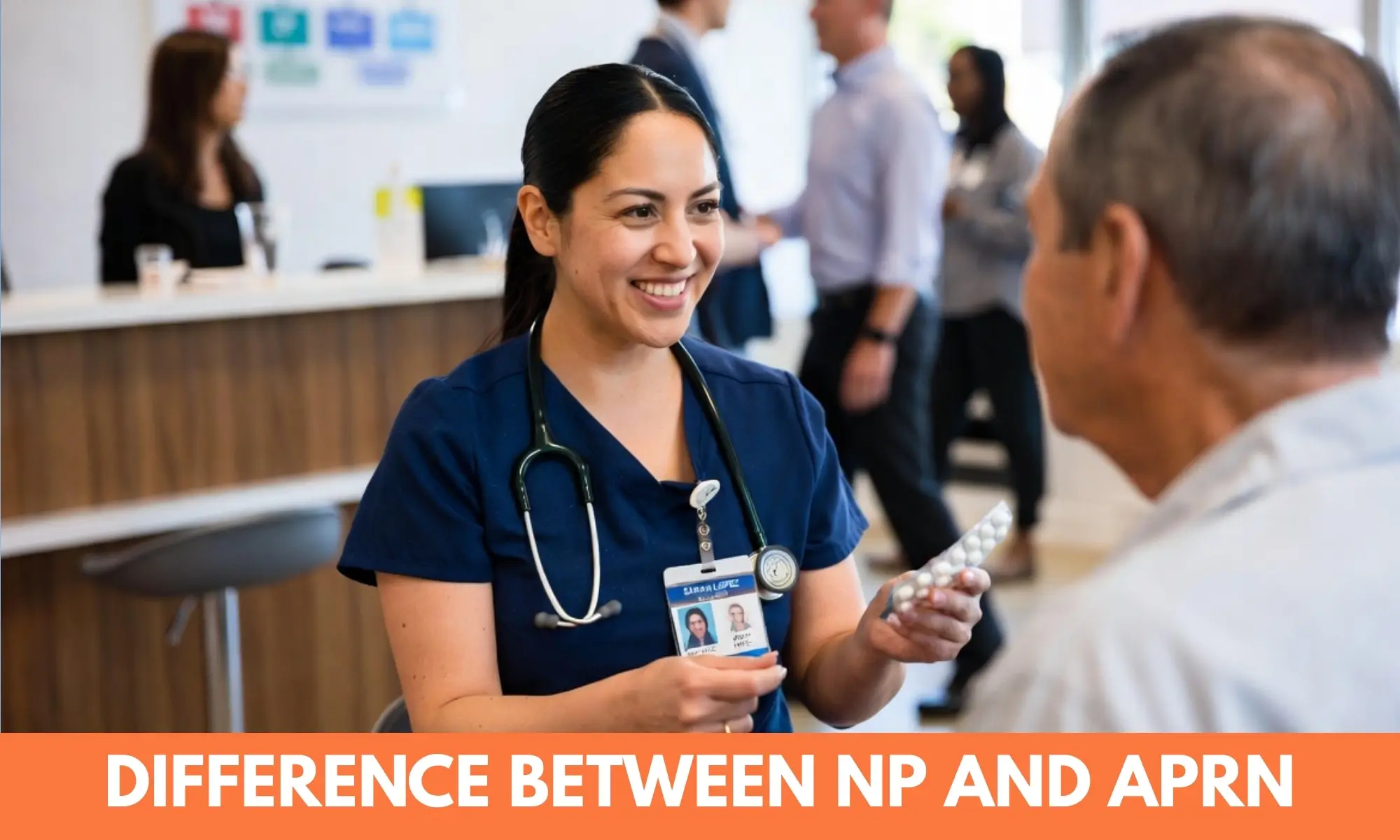
Imagine Sarah, a dedicated nurse in a busy Chicago ER. After years of bedside care, she decides to advance her career to have more autonomy in patient diagnosis.
She enrolls in a Master’s program to become an Advanced Practice Registered Nurse (APRN). However, within that broad category, she chooses to specialize as a Nurse Practitioner (NP).
To the average patient, she is simply “the provider,” but in the medical world, the difference between NP and APRN is a matter of professional identity and scope.
An APRN is the massive umbrella that shields various high-level nursing roles, while an NP is one specific, highly popular path under that shield. Understanding the difference between NP and APRN is essential for healthcare navigation.
Without grasping the difference between NP and APRN, patients might not realize that while every NP is an APRN, not every APRN is qualified to be your primary care provider.
The Key Difference Between the Both
The primary difference between NP and APRN lies in their hierarchy and specialization. APRN is a broad professional category (an umbrella term) that includes four distinct roles. An NP is just one of those four specific roles. Think of it like the relationship between a “Physician” and a “Pediatrician”; one is the general category, and the other is the specific job.
Why Their Difference is Necessary for Learners and Society
For students, knowing this distinction prevents them from applying to the wrong certification programs. For society, it ensures that healthcare systems are staffed correctly. If a hospital needs someone to administer anesthesia, they need a specific type of APRN (a CRNA), not necessarily an NP. Understanding these roles ensures patients receive specialized care from the right expert, reducing medical errors and optimizing community health outcomes.
Pronunciation Guide
- NP (Nurse Practitioner)
- US: /ɛn piː/
- UK: /ɛn piː/
- APRN (Advanced Practice Registered Nurse)
- US: /ˌeɪ piː ɑːr ˈɛn/
- UK: /ˌeɪ piː ɑːr ˈɛn/
So, how do these two designations actually play out in the hospital hallways and clinic offices? Let’s break down the technicalities.
10 Points of Difference Between NP and APRN
1. Classification
APRN is the overarching umbrella title. NP is a sub-category under that umbrella.
- Example 1: A hospital directory lists all “APRNs” on staff.
- Example 2: Sarah’s badge specifically says “NP” because that is her clinical role.
2. Scope of Roles
The APRN category includes NPs, Certified Nurse Midwives (CNMs), Clinical Nurse Specialists (CNSs), and Certified Registered Nurse Anesthetists (CRNAs). The NP focuses specifically on primary or acute care.
- Example 1: An APRN might be a midwife delivering a baby.
- Example 2: An NP is likely the one prescribing your blood pressure medication.
3. Patient Interaction
NPs generally have the highest level of direct, long-term patient interaction. Other APRNs, like Nurse Anesthetists, may only see a patient while they are unconscious.
- Example 1: An NP manages a patient’s chronic diabetes over ten years.
- Example 2: A CRNA (APRN) monitors a patient’s vitals during a two-hour surgery.
4. Certification Exams
To become an NP, you take a specific NP board exam (like AANP or ANCC). To be an APRN, you must pass the exam relevant to one of the four specific APRN branches.
- Example 1: Mark studies for the Family Nurse Practitioner exam.
- Example 2: Jennifer studies for the Psychiatric Mental Health CNS exam.
5. Focus of Care
NPs are often “population-focused” (e.g., pediatrics, geriatrics). Other APRNs may be “task-focused” or “system-focused.”
- Example 1: An NP specializes in Women’s Health.
- Example 2: A Clinical Nurse Specialist (APRN) focuses on improving the nursing protocols for an entire oncology ward.
6. Autonomy in Prescribing
NPs are widely recognized for their prescriptive authority in most states. While other APRNs can prescribe, their roles (like Anesthetists) often involve administration rather than outpatient prescriptions.
- Example 1: An NP writes a refill for an antibiotic.
- Example 2: An APRN (CRNA) chooses the dosage of sedative for a localized procedure.
7. Education Path
All NPs must follow an APRN educational track, but they choose “Nurse Practitioner” as their concentration.
- Example 1: A student enters an “APRN program” with a focus on Adult-Gerontology NP.
- Example 2: A student enters an “APRN program” to become a Nurse Midwife.
8. Workplace Environment
NPs are commonly found in private clinics and urgent cares. APRNs like CNSs are more often found in administrative or consultative roles within large hospitals.
- Example 1: You see an NP at the local “Minute Clinic.”
- Example 2: An APRN (CNS) works in a hospital office developing new safety training for nurses.
9. Historical Development
The NP role was created in the 1960s to address doctor shortages. The APRN “umbrella” was formalized later to unify various advanced nursing roles under one regulatory body.
- Example 1: The NP role started primarily in rural primary care.
- Example 2: The APRN Consensus Model was created in 2008 to standardize all four roles.
10. Direct vs. Indirect Care
NPs are almost exclusively direct care providers. Some APRN roles, specifically the Clinical Nurse Specialist, can be 50% indirect care (research and policy).
- Example 1: An NP spends 8 hours a day seeing patients in exam rooms.
- Example 2: A CNS (APRN) spends half their day analyzing infection rate data.
Nature and Behavior
- Nature of APRN: It is regulatory and foundational. It represents the legal status of having an advanced license beyond a standard RN.
- Nature of NP: It is clinical and diagnostic. It represents the actual “doing” of medicine—diagnosing, treating, and managing patients.
Why is there confusion?
The confusion stems from the fact that “APRN” is a legal license, while “NP” is a job title. People often use them interchangeably because NPs make up the largest percentage (roughly 70%) of all APRNs. It’s like calling every soda a “Coke.”
Comparison Table: NP vs. APRN
| Feature | Nurse Practitioner (NP) | APRN (Umbrella Category) |
| Relation | A specific type of APRN | The category containing NPs |
| Typical Goal | Primary or Acute Patient Care | Advanced clinical/systemic nursing |
| Includes | FNP, PNP, AGNP, PMHNP | NP, CRNA, CNS, CNM |
| Prescriptive Power | High / Outpatient focused | Varies by specific sub-role |
| Work Setting | Clinics, Offices, ERs | Hospitals, Surgical Suites, Clinics |
| Similarity | Requires a Master’s or Doctorate | Requires a Master’s or Doctorate |
| Similarity | Must have an active RN license | Must have an active RN license |
Which is better in what situation?
Becoming an NP is better if your passion lies in being a “primary provider.” If you want to have your own patient panel, diagnose illnesses, and act similarly to a family physician, the NP route is the most direct and rewarding path. It offers the most flexibility in terms of where you can work, from rural clinics to urban hospitals.
Focusing on the broader APRN roles (like CRNA or CNS) is better if you have a niche interest. For instance, if you love the high-stakes environment of the operating room but don’t want to manage long-term patient files, becoming a CRNA (under the APRN umbrella) is superior. If you enjoy teaching other nurses and changing hospital policy, the CNS role is a better fit than the NP role.
Metaphors, Similes, and Connotations
- Metaphor: An APRN is the “Stem” of a plant; the NP is one of the “Flowers” blooming from it.
- Simile: An NP is like a Swiss Army Knife—versatile and ready for any patient issue—while an APRN is the entire toolbox.
Connotative Meanings
- APRN:Connotation: Formal/Institutional. It sounds highly “official” and “regulatory.”
- Example: “The state board updated the APRN requirements.”
- NP:Connotation: Relatable/Clinical. It sounds like a “provider” you can talk to.
- Example: “I need to go see my NP for my annual physical.”
Idioms and Proverbs
- “Too many cooks in the kitchen”
- Example: Without a clear distinction between the NP and the CNS (both APRNs), there can be “too many cooks in the kitchen” when deciding on a patient’s treatment plan.
- “Jack of all trades”
- Example: The NP is often a “Jack of all trades” in rural healthcare, acting as a doctor, counselor, and educator.
Literature and Media
Works in Literature
- The Future of Nursing: Leading Change, Advancing Health (Non-fiction) – Institute of Medicine (2011)
- Advanced Practice Nursing: An Integrative Approach (Textbook) – Ann Hamric (Multiple Editions)
Movies/TV Featuring Advanced Nurses
- Nurse Jackie (TV Series, 2009-2015, USA) – While she is an RN, the show highlights the push toward advanced practice.
- The Night Shift (TV Series, 2014-2017, USA) – Features various high-level nursing roles in an ER setting.
Frequently Asked Questions (FAQs)
- Is an NP higher than an APRN? No, an NP is a type of APRN. They are on the same educational level.
- Can an APRN perform surgery? Generally, no. While CRNAs (APRNs) assist in surgery via anesthesia, they do not perform the surgical procedure itself.
- Do NPs get paid more than other APRNs? Not necessarily. CRNAs (another type of APRN) actually tend to have the highest salaries in the nursing field.
- Are all APRNs called “Doctor”? Some have a DNP (Doctor of Nursing Practice), but their clinical title remains NP or APRN.
- Can I be an APRN without being an NP? Yes, you can be a Midwife (CNM) or a Nurse Anesthetist (CRNA).
Conclusion
Both NPs and APRNs are the backbone of modern medicine. They bridge the gap between traditional nursing and physician-led care, providing a “human touch” to complex medical science.
In a world with increasing healthcare demands, these professionals are more useful for their surroundings than ever, offering affordable, accessible, and high-quality care to underserved populations. In conclusion, the difference between NP and APRN is a matter of hierarchy.
APRN is the elite club of advanced nurses, and the NP is its most prominent member. Whether you are a student planning your career or a patient looking at a name tag, knowing this distinction ensures clarity in a complex system.
While the titles may vary, the dedication to patient health remains the core of both designations.