Have you ever felt an overwhelming crush and wondered if it was true love or just limerence? Understanding the difference between love and limerence can save hearts from confusion.
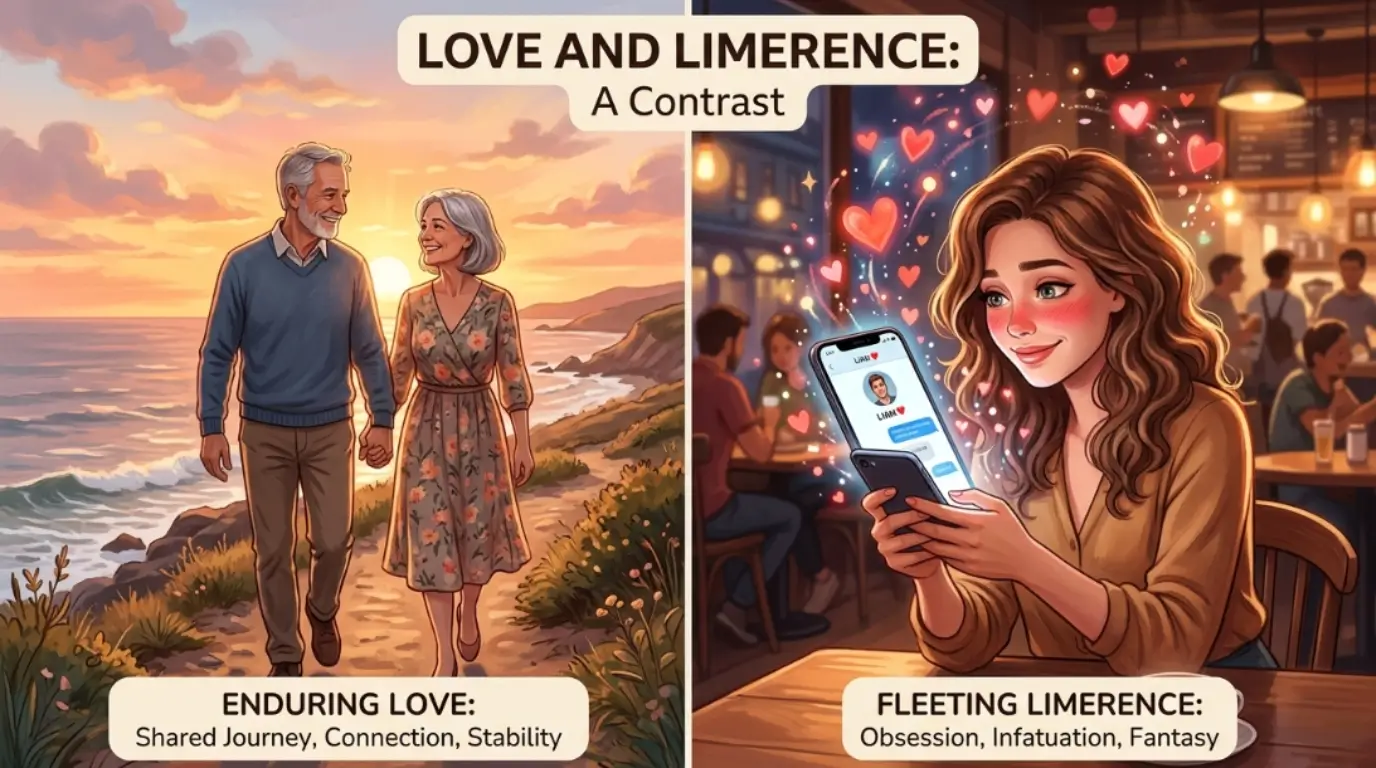
Love is a deep, enduring emotional bond that grows over time, while limerence is an intense, often obsessive infatuation that can fade quickly.
Imagine a friend who constantly thinks about someone new, feeling excitement and nervousness at every message—this is limerence in action.
On the other hand, love is seen in a couple who supports each other through hardships and joys. Pronunciation: Love – /lʌv/ (US & UK), Limerence – /ˈlɪm.ə.rəns/ (US & UK).
Understanding this difference can guide relationships, emotional growth, and social harmony. Let’s dive deeper into the nuances of these emotions.
Difference Between Love and Limerence
1. Duration
- Love: Long-lasting, stable, can endure years.
Example 1: Parents supporting each other through decades of marriage.
Example 2: Lifelong friendships based on trust and care. - Limerence: Short-term, intense, and often temporary.
Example 1: Crushing on a coworker for a few months.
Example 2: Obsessing over a celebrity for weeks.
2. Emotional Intensity
- Love: Balanced, calm, comforting.
Example 1: Partner feeling safe during hard times.
Example 2: Deep satisfaction in helping someone unconditionally. - Limerence: Extreme highs and lows, obsessive thoughts.
Example 1: Heart racing after a simple text from crush.
Example 2: Anxiety when a message is delayed.
3. Focus
- Love: Centered on mutual growth and care.
- Limerence: Focused on one’s own emotional pleasure from the other person.
4. Attachment
- Love: Healthy, flexible, allows personal space.
- Limerence: Dependent, craving constant reassurance.
5. Realism vs Idealism
- Love: Sees the partner realistically, accepts flaws.
- Limerence: Idealizes the person, often ignoring imperfections.
6. Motivation
- Love: Motivated by empathy, kindness, shared life goals.
- Limerence: Motivated by desire, attraction, and emotional thrills.
7. Physical vs Emotional
- Love: Emotional and physical closeness is balanced.
- Limerence: Emotional rush often dominates over genuine connection.
8. Behavior
- Love: Thoughtful, patient, supportive.
- Limerence: Anxious, clingy, overly reactive.
9. Communication
- Love: Open, honest, constructive.
- Limerence: One-sided, craving attention or validation.
10. Stability
- Love: Provides emotional stability and long-term bonding.
- Limerence: Volatile, can lead to disappointment if not reciprocated.
Nature and Behavior
Love: Nurturing, compassionate, reliable, adaptable, and patient.
Limerence: Intense, obsessive, thrilling but unstable, and sometimes irrational.
Why People Confuse Them: Both involve strong emotions and desire for closeness, but limerence mimics love superficially, often leading to misinterpretation.
Table of Differences and Similarities
| Feature | Love | Limerence | Similarities |
| Duration | Long-term | Short-term | Emotional engagement |
| Intensity | Balanced | Extreme | Attraction to someone |
| Focus | Mutual growth | Self-centered | Desire for closeness |
| Realism | Accepts flaws | Idealizes | Emotional investment |
| Stability | Stable | Volatile | Can feel happiness |
| Communication | Honest & open | Craving attention | Thoughts about person |
| Attachment | Flexible | Dependent | Passion present |
| Motivation | Care & empathy | Desire & thrill | Both affect mood |
| Physical/Emotional | Balanced | Emotional dominant | Physical attraction possible |
| Behavioral Pattern | Patient & supportive | Obsessive & anxious | Both involve thinking about someone |
Which is Better in What Situation?
Love is better for long-term, meaningful relationships that provide emotional growth, stability, and mutual support. Limerence can be enjoyable for short-term excitement and self-discovery but is risky for serious commitment. Understanding when each is at play helps make informed choices and avoids heartbreak.
Metaphors, Similes, and Connotation
- Love: “Love is a warm fire in winter” (positive).
- Limerence: “Limerence is a lightning bolt, bright but fleeting” (neutral/negative).
Idioms/Proverbs
- Love: “Absence makes the heart grow fonder.”
- Limerence: “Falling head over heels” (used for intense infatuation).
Literature Featuring the Keywords
- Love: Pride and Prejudice by Jane Austen (1813, Novel)
- Limerence: Lolita by Vladimir Nabokov (1955, Novel)
Movies About the Keywords
- Love Actually (2003, UK)
- Her (2013, US) – explores limerence-like obsession
FAQs
- Can love turn into limerence?
Yes, initial love can feel limerent when excitement dominates. - Is limerence harmful?
If uncontrolled, it may cause obsession or disappointment. - Can limerence lead to true love?
Occasionally, if emotions mature and grow into stable care. - Why do people confuse them?
Both involve attraction and desire for closeness. - Is love always positive?
Generally, yes; it promotes growth and well-being.
How Both Are Useful for Surroundings
Love fosters supportive communities, strengthens families, and promotes empathy. Limerence, while intense, can spark creativity, inspire art, and encourage self-reflection, though it is less stable for social structures.
Conclusion
Understanding the difference between love and limerence is vital for emotional intelligence and healthy relationships.
While love builds lasting bonds and emotional security, limerence provides a short-lived thrill that can teach us about desire and attraction. Recognizing these patterns prevents confusion, heartbreak, and misjudged relationships.
Whether in literature, films, or real-life interactions, distinguishing love from limerence enables deeper self-awareness and richer connections with others. Embrace love for stability and limerence for excitement, but always balance the two wisely.