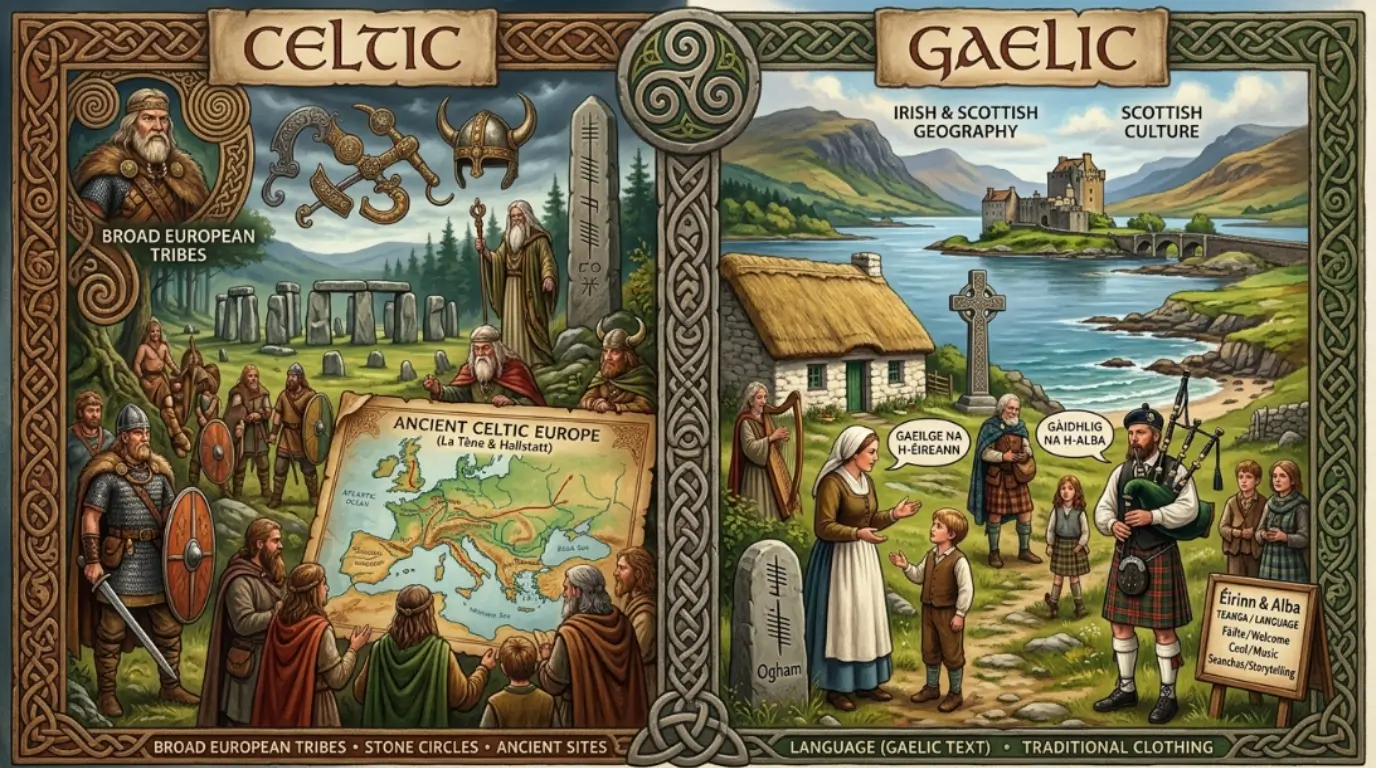
Imagine you’re traveling through the green hills of Ireland and Scotland, hearing locals speak in rich, musical tones. Someone mentions Celtic traditions, while another talks about Gaelic language.
At first, they sound similar—but are they the same? Understanding the difference between Celtic and Gaelic can feel confusing, especially since both are deeply connected to history, culture, and identity.
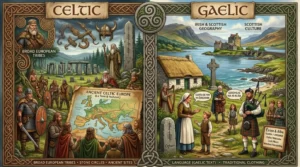
The difference between Celtic and Gaelic lies in their meaning and scope. While “Celtic” refers to a broad group of people, cultures, and languages, “Gaelic” is more specific.
Many learners struggle with the difference between Celtic and Gaelic, especially when exploring European heritage. Knowing the difference between Celtic and Gaelic helps both beginners and experts better understand language roots and cultural identity.
Let’s explore this fascinating distinction step by step.
Key Difference Between Celtic and Gaelic
The difference between Celtic and Gaelic is simple:
- Celtic = A large cultural and linguistic family
- Gaelic = A specific branch within the Celtic family
Celtic is the umbrella, and Gaelic is one part of it.
Why Is It Important to Know the Difference?
Understanding the difference between Celtic and Gaelic helps learners avoid confusion when studying history, language, or culture. It also allows experts to correctly categorize traditions, literature, and linguistic origins.
For society, this knowledge preserves identity. For example, calling all Celtic languages “Gaelic” ignores diversity. Knowing the difference ensures respect for each culture’s uniqueness.
Pronunciation (US & UK)
- Celtic
- US: SEL-tik /ˈsɛltɪk/ or KEL-tik /ˈkɛltɪk/
- UK: Mostly KEL-tik /ˈkɛltɪk/
- Gaelic
- US: GAY-lik /ˈɡeɪlɪk/
- UK: GAL-ik /ˈɡælɪk/ or GAY-lik
👉 Now that you know how they sound, let’s dive deeper into their differences.
Difference Between Celtic and Gaelic (10 Key Points)
1. Meaning
- Celtic: A broad cultural group
- Example 1: Celtic tribes lived across Europe
- Example 2: Celtic art includes unique knot designs
- Gaelic: A language group
- Example 1: Irish Gaelic is spoken in Ireland
- Example 2: Scottish Gaelic is spoken in Scotland
2. Scope
- Celtic: Includes many languages
- Example 1: Welsh is Celtic
- Example 2: Breton is Celtic
- Gaelic: Only includes a few languages
- Example 1: Irish
- Example 2: Scottish Gaelic
3. Geography
- Celtic: Spread across Europe
- Example 1: France (Brittany)
- Example 2: Wales
- Gaelic: Limited regions
- Example 1: Ireland
- Example 2: Scottish Highlands
4. Language Family
- Celtic: Entire language family
- Example 1: Brythonic languages
- Example 2: Goidelic languages
- Gaelic: Sub-branch (Goidelic)
- Example 1: Irish Gaelic
- Example 2: Manx
5. Usage
- Celtic: Cultural identity
- Example 1: Celtic festivals
- Example 2: Celtic music
- Gaelic: Spoken language
- Example 1: Gaelic classes
- Example 2: Gaelic radio
6. Origin
- Celtic: Ancient tribes
- Example 1: Iron Age Europe
- Example 2: Early migrations
- Gaelic: Derived languages
- Example 1: Old Irish
- Example 2: Evolution into modern dialects
7. Cultural Role
- Celtic: Includes myths and traditions
- Example 1: Celtic mythology
- Example 2: Celtic symbols
- Gaelic: Preserves language heritage
- Example 1: Gaelic storytelling
- Example 2: Gaelic poetry
8. Modern Presence
- Celtic: Widely recognized identity
- Example 1: Celtic festivals worldwide
- Example 2: Celtic sports teams
- Gaelic: Limited speakers
- Example 1: Irish schools
- Example 2: Scottish communities
9. Education
- Celtic: Studied in history
- Example 1: University courses
- Example 2: Cultural studies
- Gaelic: Taught as a language
- Example 1: Language classes
- Example 2: Online learning
10. Recognition
- Celtic: Broad term
- Example 1: Celtic nations
- Example 2: Celtic heritage
- Gaelic: Specific identity
- Example 1: Gaelic speakers
- Example 2: Gaelic literature
Nature and Behaviour
- Celtic: Broad, inclusive, cultural
- Gaelic: Specific, linguistic, traditional
Why People Get Confused
People confuse them because Gaelic is part of Celtic. Since both relate to Ireland and Scotland, many assume they mean the same thing—but they don’t.
Table: Difference & Similarity
| Aspect | Celtic | Gaelic |
| Type | Cultural & language family | Language branch |
| Scope | Broad | Narrow |
| Includes | Welsh, Breton, Gaelic | Irish, Scottish, Manx |
| Usage | Culture & identity | Language |
| Similarity | Both relate to European heritage | Both share historical roots |
Which Is Better in What Situation?
Use Celtic when talking about culture, history, or a wide group of people. For example, “Celtic traditions” fits best.
Use Gaelic when referring to language. For example, “Gaelic language classes” is correct.
Neither is “better”—they serve different purposes.
Metaphors and Similes
- Celtic (positive): “Celtic culture is a rich tapestry”
- Gaelic (neutral): “Gaelic flows like a melody”
Connotative Meaning
- Celtic: Positive (heritage, pride)
- Gaelic: Neutral to positive (language, tradition)
Idioms / Proverbs
(Not many direct idioms exist, but examples include:)
- “Keep the Celtic spirit alive”
- “Speak your Gaelic roots proudly”
Works in Literature
- Celtic Twilight – Folklore, W.B. Yeats, 1893
- Irish Gaelic Stories – Folklore, Various, 19th century
- The Mabinogion – Mythology, Welsh Celtic, 12th century
Movies Related
- Braveheart (1995, USA/UK) – Celtic Scotland
- The Secret of Kells (2009, Ireland) – Celtic art
- Song of the Sea (2014, Ireland) – Gaelic folklore
FAQs
1. Are Celtic and Gaelic the same?
No. Celtic is broader, Gaelic is a part of it.
2. Is Irish Celtic or Gaelic?
It is both—Irish is a Gaelic language within the Celtic family.
3. Why is Gaelic important?
It preserves cultural and linguistic heritage.
4. Can Celtic refer to language?
Yes, but it includes multiple languages, not just Gaelic.
5. Where are they used today?
Mainly in Ireland, Scotland, and parts of Europe.
How Both Are Useful for Society
Celtic helps preserve cultural identity and traditions. Gaelic keeps ancient languages alive. Together, they enrich global diversity and historical understanding.
Conclusion
The difference between Celtic and Gaelic becomes clear when you see the bigger picture. Celtic is the wide cultural umbrella that covers many traditions, languages, and identities.
Gaelic, on the other hand, is a specific branch within that umbrella, focusing mainly on language. Understanding the difference between Celtic and Gaelic helps learners, writers, and researchers communicate more accurately. It also ensures respect for cultural diversity.
Whether you’re exploring history, language, or identity, knowing this difference adds depth to your knowledge and appreciation of European heritage.