Imagine you send an important message at work and your boss replies, “I confirm this is correct.” Later, a friend says, “I affirm your decision.” Both sound similar, right?
But they carry slightly different meanings. Understanding the difference between affirm and confirm can help you speak and write more clearly in daily life.
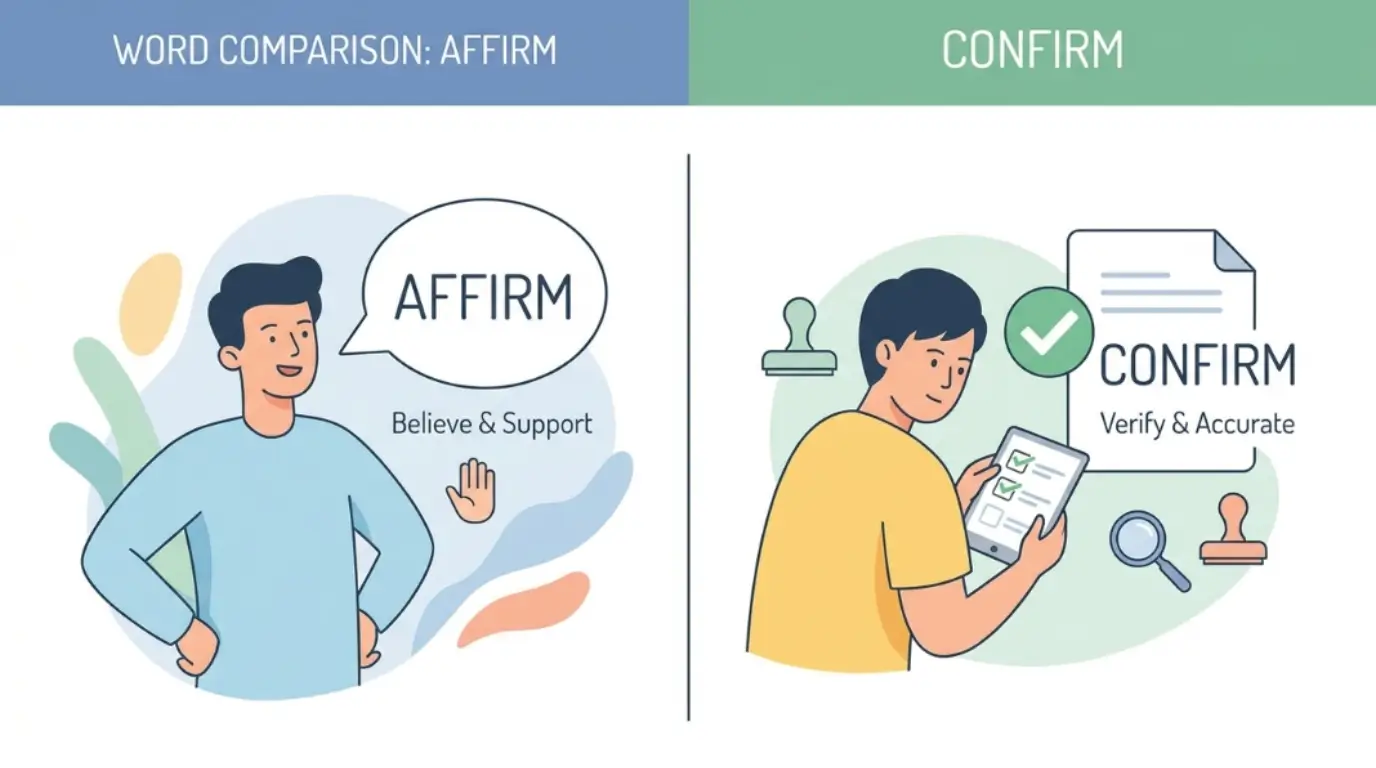
To affirm means to state something strongly or confidently, often as a belief or opinion. To confirm means to check or prove that something is true or correct. Many people mix them up because both relate to saying something is true. But their usage depends on context.
Knowing the difference between affirm and confirm helps students, professionals, and writers avoid confusion and communicate accurately. Let’s break it down step by step in the simplest way possible.
Key Difference Between Affirm and Confirm
The main difference between affirm and confirm is:
- Affirm = Express belief or support strongly
- Confirm = Verify or prove something is true
Example:
- “I affirm your idea.” (I strongly support it)
- “I confirm your booking.” (I check and verify it is correct)
Why Is This Difference Important?
Understanding the difference between affirm and confirm is important for clear communication.
Students need it for writing correct sentences.
Professionals use it in emails, reports, and meetings.
Experts rely on it for precise meaning in legal or formal contexts.
In society, using the right word avoids misunderstandings. For example, in law or business, confusing “affirm” with “confirm” can change the meaning of a statement completely.
Pronunciation (US & UK)
- Affirm
- US: uh-FIRM
- UK: uh-FIRM
- Confirm
- US: kuhn-FURM
- UK: kuhn-FURM
Now that you know how they sound, let’s explore their differences in detail.
Difference Between Affirm and Confirm (10 Clear Points)
1. Meaning
- Affirm = Strongly state or support
- Confirm = Verify or prove
Examples:
- I affirm your honesty.
- I confirm the meeting time.
2. Purpose
- Affirm = Express belief
- Confirm = Check accuracy
Examples:
- She affirmed her loyalty.
- He confirmed the results.
3. Usage Context
- Affirm = Emotional or personal
- Confirm = Practical or factual
Examples:
- I affirm my values.
- Please confirm your email.
4. Tone
- Affirm = Strong and confident
- Confirm = Neutral and factual
Examples:
- He affirmed his decision firmly.
- She confirmed the schedule calmly.
5. Field of Use
- Affirm = Often used in law or personal beliefs
- Confirm = Used in business and daily tasks
Examples:
- The judge affirmed the ruling.
- The company confirmed the order.
6. Focus
- Affirm = Opinion or belief
- Confirm = Fact or evidence
Examples:
- I affirm your courage.
- I confirm your payment.
7. Emotional Connection
- Affirm = Emotional support
- Confirm = Logical proof
Examples:
- She affirmed her love.
- He confirmed the data.
8. Formal Use
- Affirm = Formal and strong
- Confirm = Common and practical
Examples:
- He affirmed the statement in court.
- She confirmed her attendance.
9. Action Type
- Affirm = Declare
- Confirm = Verify
Examples:
- I affirm my position.
- I confirm your booking.
10. Result
- Affirm = Builds trust or belief
- Confirm = Provides certainty
Examples:
- His words affirmed my confidence.
- The test confirmed the diagnosis.
Nature and Behaviour of Both Words
Affirm shows confidence, belief, and emotional strength. It is often used when someone wants to express support or stand by something.
Confirm is practical and fact-based. It focuses on checking information and making sure something is correct.
Why Are People Confused?
People confuse them because both words relate to truth.
- Both involve saying something is true
- Both are used in formal language
- Their meanings overlap slightly
But remember:
Affirm = belief
Confirm = proof
Difference & Similarity Table
| Feature | Affirm | Confirm |
| Meaning | Declare strongly | Verify truth |
| Focus | Belief/opinion | Fact/evidence |
| Tone | Emotional/strong | Neutral/practical |
| Usage | Personal/legal | Business/daily use |
| Similarity | Both relate to truth | Both relate to truth |
Which Is Better in What Situation?
Use affirm when you want to express strong belief, support, or emotion. For example, in speeches, personal conversations, or legal statements, affirm works best.
Use confirm when you need to check facts or verify information. It is ideal for emails, bookings, reports, and professional communication.
Metaphors and Similes
- Affirm: “Her words affirmed me like sunlight on a cold day.”
- Confirm: “The evidence confirmed the truth like a clear mirror.”
Connotative Meaning
Affirm → Positive (confidence, support)
- Example: He affirmed his commitment.
Confirm → Neutral (verification, certainty)
- Example: She confirmed the details.
Idioms or Proverbs
(No direct idioms, but used in sentences)
- I affirm that honesty is the best policy.
- Please confirm before you act.
Works in Literature
- To Kill a Mockingbird – Harper Lee (1960, Fiction)
- 1984 – George Orwell (1949, Dystopian Fiction)
(Both use themes of truth, affirmation, and confirmation in dialogue.)
Movies Related to the Concept
- A Few Good Men (1992, USA)
- The Social Network (2010, USA)
FAQs
1. What is the main difference between affirm and confirm?
Affirm means to strongly support. Confirm means to verify facts.
2. Can they be used interchangeably?
No, because their meanings are slightly different.
3. Which is more formal?
Both are formal, but affirm sounds stronger.
4. Where is confirm commonly used?
In emails, bookings, and business communication.
5. Why is affirm important?
It helps express confidence and support in communication.
Conclusion
The difference between affirm and confirm may seem small, but it matters a lot in communication.
Affirm focuses on belief and emotional strength, while confirm deals with facts and verification. Using them correctly makes your message clear and professional.
Whether you are writing an email, giving a speech, or having a conversation, knowing when to use each word can improve your language skills. Keep practicing, and soon the difference will feel natural.