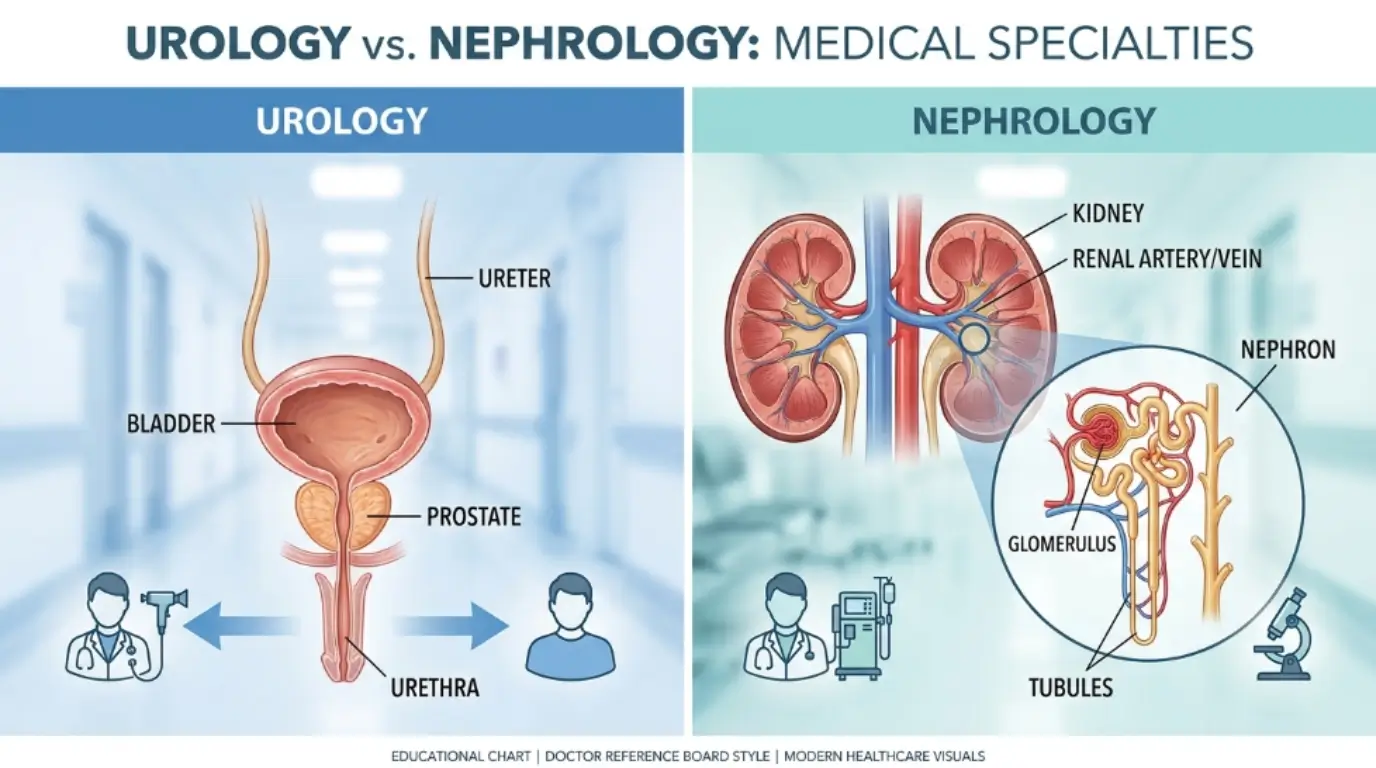
A man once visited a hospital because he was suffering from severe back pain and difficulty urinating. He first met a kidney specialist, but later he was referred to another doctor for surgery.
This real-life situation explains why many people remain confused about the difference between urology and nephrology.
Both medical fields deal with kidneys and the urinary system, yet their roles are different.
Understanding the difference between urology and nephrology is important for patients, students, healthcare workers, and researchers.
In hospitals, these specialties often work together to diagnose and treat diseases related to the kidneys, bladder, and urinary tract.
The difference between urology and nephrology becomes clear when we look at their treatment methods, areas of focus, and patient care.
Learning the difference between urology and nephrology helps people choose the right doctor at the right time and improves healthcare awareness in society.
Pronunciation of Urology and Nephrology
Urology
- US Pronunciation: yoo-ROL-uh-jee
- UK Pronunciation: yoo-ROL-uh-jee
Nephrology
- US Pronunciation: neh-FROL-uh-jee
- UK Pronunciation: neh-FROL-uh-jee
Both fields may sound similar because they are related to kidney and urinary health, but their medical purposes are different. Let us now move toward the main comparison to understand their unique roles in healthcare.
Difference Between Urology and Nephrology
| Feature | Urology | Nephrology |
| Main Focus | Urinary tract and male reproductive system | Kidney function and kidney diseases |
| Type of Specialist | Surgeon and physician | Physician only |
| Surgery | Performs surgeries | Does not usually perform surgery |
| Organs Treated | Bladder, urethra, prostate, kidneys | Mainly kidneys |
| Common Diseases | Kidney stones, prostate issues, urinary blockage | Kidney failure, hypertension, dialysis |
| Diagnostic Tools | Cystoscopy, imaging, surgery | Blood tests, urine tests, dialysis monitoring |
| Treatment Style | Surgical and medical | Mostly medical management |
| Patient Type | Men and women with urinary problems | Patients with kidney disorders |
| Training Focus | Surgical procedures | Internal medicine and kidney care |
| Example Procedure | Removal of kidney stones | Dialysis management |
Similarity Between Both
| Similarities |
| Both deal with kidney-related health problems |
| Both help patients with urinary disorders |
| Both work together in hospitals |
| Both require advanced medical training |
| Both improve overall urinary system health |
10 Major Points of Difference Between Urology and Nephrology
1. Area of Specialization
Urology focuses on the urinary tract and male reproductive organs. Nephrology focuses mainly on kidney health and kidney diseases.
Examples of Urology
- Treating enlarged prostate
- Removing bladder stones
Examples of Nephrology
- Managing kidney failure
- Treating chronic kidney disease
2. Surgical vs Non-Surgical Nature
Urologists are trained surgeons. Nephrologists mainly use medicines and therapies.
Examples of Urology
- Kidney stone surgery
- Prostate surgery
Examples of Nephrology
- Dialysis treatment
- Blood pressure management for kidneys
3. Organs Treated
Urology covers kidneys, bladder, ureters, urethra, and male reproductive organs. Nephrology mainly studies kidneys.
Examples of Urology
- Bladder infection treatment
- Testicular disorder treatment
Examples of Nephrology
- Kidney inflammation treatment
- Electrolyte imbalance care
4. Type of Diseases
Urologists treat structural problems. Nephrologists treat functional kidney disorders.
Examples of Urology
- Urinary blockage
- Kidney stones
Examples of Nephrology
- Kidney failure
- Diabetic kidney disease
5. Diagnostic Methods
Urology uses imaging and scopes. Nephrology uses laboratory tests.
Examples of Urology
- CT scan for stones
- Cystoscopy
Examples of Nephrology
- Urine protein test
- Kidney function blood test
6. Treatment Procedures
Urologists often perform procedures. Nephrologists manage long-term care.
Examples of Urology
- Catheter insertion
- Tumor removal surgery
Examples of Nephrology
- Dialysis planning
- Medication for kidney protection
7. Relation With Male Reproductive System
Urology also treats male fertility and reproductive problems. Nephrology does not.
Examples of Urology
- Erectile dysfunction treatment
- Male infertility care
Examples of Nephrology
- Kidney infection management
- Blood filtration treatment
8. Hospital Departments
Urology is commonly linked with surgery departments. Nephrology belongs to internal medicine.
Examples of Urology
- Operation theater procedures
- Surgical emergency care
Examples of Nephrology
- Dialysis unit management
- Intensive kidney monitoring
9. Patient Conditions
Urology patients often have pain or blockage. Nephrology patients may have chronic diseases.
Examples of Urology
- Painful urination
- Stone blockage
Examples of Nephrology
- Long-term kidney disease
- Kidney damage from diabetes
10. Emergency Situations
Urology handles surgical emergencies. Nephrology handles medical emergencies.
Examples of Urology
- Emergency stone removal
- Severe urinary retention
Examples of Nephrology
- Sudden kidney failure
- Dangerous electrolyte imbalance
Nature and Behaviour of Both
Nature of Urology
Urology is practical and procedure-based. It combines surgery with medical treatment. Urologists often deal with immediate physical problems that may require operations.
Nature of Nephrology
Nephrology is research-oriented and medically focused. It studies how kidneys function and how diseases affect the body over time. Nephrologists often manage chronic illnesses.
Why People Are Confused About Their Use?
People become confused because both specialties deal with kidneys and urinary health. Many symptoms such as back pain, blood in urine, or urinary infection may overlap. Hospitals also place both departments close to each other. Another reason is that kidney diseases sometimes require both medical treatment and surgery, so urologists and nephrologists work together.
Why Their Difference Is Necessary to Know for Learners and Experts
Understanding the difference is important because it helps patients select the correct specialist quickly. Medical students and healthcare professionals also benefit from knowing the distinction because proper diagnosis saves time and improves treatment quality.
In society, both fields are highly important. Kidney diseases are increasing due to diabetes, obesity, and hypertension. Urologists help with surgical and structural problems, while nephrologists help manage long-term kidney health. Together, they reduce suffering and improve public health systems.
Which Is Better in What Situation?
When Urology Is Better
Urology is better when a patient has a structural or surgical problem. Conditions like kidney stones, prostate enlargement, urinary blockage, bladder tumors, or male reproductive issues require a urologist. A urologist can perform surgeries and procedures that remove physical obstructions and repair urinary organs. Patients with severe pain during urination or sudden urinary retention usually need immediate urological care.
When Nephrology Is Better
Nephrology is better when kidney function itself is damaged. Patients with chronic kidney disease, kidney failure, uncontrolled blood pressure, or dialysis needs should visit a nephrologist. These specialists focus on preserving kidney function and preventing further damage through medicines, lifestyle management, and monitoring. Long-term conditions related to diabetes and hypertension often require nephrology care.
How the Keywords Are Used in Metaphors and Similes
Urology in Metaphors
- “The plumber of the human body”
- Example: “The urologist acted like a plumber fixing blocked pipes.”
Nephrology in Metaphors
- “The guardian of body filtration”
- Example: “A nephrologist protects the kidneys like a filter engineer.”
Similes
- “Kidneys work like water purifiers.”
- “A urologist repairs the urinary tract like a mechanic repairing pipes.”
Connotative Meaning of Both Keywords
| Keyword | Connotation | Example |
| Urology | Neutral to positive | “Urology helped the patient recover from painful stones.” |
| Nephrology | Neutral to positive | “Nephrology improved the patient’s kidney function.” |
Negative Context Examples
- “The patient feared visiting urology because surgery was needed.”
- “Nephrology became necessary after kidney failure developed.”
Idioms or Proverbs Related to the Words
There are no direct idioms for these medical terms, but related health expressions exist.
“Prevention is better than cure”
Example: “Regular kidney checkups prove that prevention is better than cure.”
“Health is wealth”
Example: “People understand health is wealth after facing kidney disease.”
Works in Literature Related to the Keywords
Urology-Related Works
- Campbell-Walsh Urology — Medical textbook, edited by Alan Wein, 1954
- Smith’s General Urology — Medical reference book, Emil Tanagho, 1957
Nephrology-Related Works
- The Kidney — Medical science book, Barry Brenner, 1976
- Oxford Handbook of Nephrology and Hypertension — Medical handbook, 2006
Movie Names Related to Kidney or Urinary Diseases
- The Doctor — 1991, USA
- Gifted Hands — 2009, USA
- Dallas Buyers Club — 2013, USA
These movies involve medical treatment, hospitals, and healthcare challenges connected with organ diseases.
Frequently Asked Questions
Is a urologist the same as a nephrologist?
No. A urologist treats urinary tract and surgical problems, while a nephrologist treats kidney diseases medically.
Who treats kidney stones?
A urologist usually treats kidney stones, especially when surgery is required.
Who handles dialysis?
A nephrologist manages dialysis treatment.
Can both specialists work together?
Yes. Complex kidney diseases may require both specialists.
Which doctor should I see for urinary infections?
Simple infections may be treated by general doctors, but severe or repeated infections may require a urologist.
How Both Are Useful for Surroundings
Both specialties improve public health by treating serious diseases early. Urology helps people recover from painful urinary conditions and improves quality of life.
Nephrology helps prevent kidney failure and supports patients with chronic diseases. Together, they reduce healthcare burdens and promote healthier communities.
Final Words for Both
Urology and nephrology are deeply connected but medically different fields. One focuses more on surgery and urinary structures, while the other focuses on kidney function and long-term medical care. Both are essential for human health and modern medicine.
Conclusion
Understanding the difference between urology and nephrology is important for patients, students, and healthcare professionals.
Although both fields deal with kidneys and urinary health, their methods and purposes differ greatly.
Urology focuses on surgical and structural disorders of the urinary tract and male reproductive organs, while nephrology focuses on kidney function and medical treatment of kidney diseases.
Knowing which specialist to consult can save time, improve diagnosis, and provide better treatment outcomes.
In today’s world, where kidney diseases and urinary disorders are increasing rapidly, both specialties play a major role in protecting human health.
Their combined contribution strengthens healthcare systems and improves the quality of life for millions of people around the world.