
Imagine Sarah, a successful lawyer who finds herself sabotaging every romantic relationship just as it gets serious. She doesn’t know why she does it.
A psychoanalytic approach might involve Sarah lying on a couch four times a week for years, tracing this back to a specific childhood fixation.
Conversely, a psychodynamic approach might see Sarah meeting a therapist once a week to focus on how her current patterns of relating to people are influenced by her past.
The difference between psychoanalytic and psychodynamic therapy often feels like a riddle. While both dive into the “unconscious,” psychoanalytic theory is the rigid, classical foundation, whereas psychodynamic therapy is the evolved, flexible descendant.
Understanding the difference between psychoanalytic and psychodynamic models helps us see how we handle trauma.
To the casual observer, they look the same, but for a patient, the difference between psychoanalytic and psychodynamic practice changes the very rhythm of their recovery.
Pronunciation Guide
- Psychoanalytic
- US: /ˌsaɪkoʊˌænəˈlɪtɪk/
- UK: /ˌsaɪkəʊˌænəˈlɪtɪk/
- Psychodynamic
- US: /ˌsaɪkoʊdaɪˈnæmɪk/
- UK: /ˌsaɪkəʊdaɪˈnæmɪk/
But how do these two schools of thought actually operate when the office door closes? Let’s pull back the curtain on their distinct mechanics.
The Core Differences Between Psychoanalytic and Psychodynamic
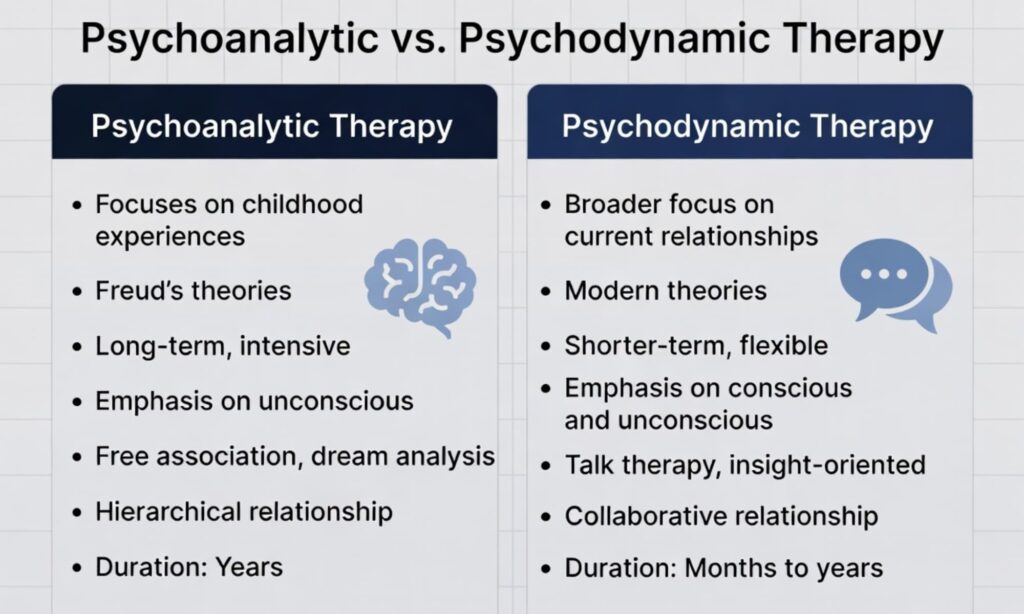
1. Frequency of Sessions
Psychoanalytic therapy is intense, usually requiring 3 to 5 sessions per week. Psychodynamic therapy is more accessible, typically occurring once or twice weekly.
- Example A: A psychoanalytic patient sees their doctor nearly every day.
- Example B: A psychodynamic patient schedules a session every Tuesday morning.
2. Duration of Treatment
Psychoanalysis often lasts for many years, aiming for a total personality overhaul. Psychodynamic therapy is shorter, often concluding within several months to a year.
- Example A: An artist stays in analysis for a decade to explore every facet of their soul.
- Example B: A student uses psychodynamic sessions for six months to resolve an identity crisis.
3. The Physical Setting
In psychoanalysis, the patient usually lies on a couch, looking away from the therapist. In psychodynamic therapy, the pair sits face-to-face.
- Example A: The patient speaks to the ceiling to encourage free association.
- Example B: The patient makes eye contact with the therapist to build a social bond.
4. Focus of Content
Psychoanalysis focuses heavily on biological drives and childhood psychosexual stages. Psychodynamic therapy focuses on the “here and now” and social relationships.
- Example A: Discussing how breastfeeding habits at age one affect current greed.
- Example B: Discussing how a boss reminds the patient of their overbearing father.
5. Role of the Therapist
The psychoanalyst is a “blank slate,” remaining neutral and silent. The psychodynamic therapist is active, engaging, and supportive.
- Example A: The therapist says nothing for thirty minutes while the patient rambles.
- Example B: The therapist asks, “How did that make you feel when your brother said that?”
6. Goal of Therapy
Psychoanalysis seeks to uncover deep-seated unconscious material. Psychodynamic therapy seeks to improve the patient’s current functioning and symptom relief.
- Example A: Aiming to resolve the Oedipus complex.
- Example B: Aiming to stop having panic attacks at work.
7. Core Theories
Psychoanalysis is strictly Freudian. Psychodynamic therapy incorporates ideas from Jung, Adler, and Klein.
- Example A: Using Freud’s “Id, Ego, and Superego” exclusively.
- Example B: Looking at “Archetypes” or “Attachment Styles.”
8. Use of Transference
Both use transference, but psychoanalysis views it as the primary tool for cure. Psychodynamic therapy uses it as one of many insights.
- Example A: Analyzing why the patient is “falling in love” with the silent doctor.
- Example B: Noticing the patient is being defensive and moving on to problem-solving.
9. Depth of Exploration
Psychoanalysis explores the “id” or primitive drives. Psychodynamic therapy focuses on “ego” functions and how one adapts to the world.
- Example A: Exploring repressed aggressive instincts.
- Example B: Exploring how a person manages stress in their marriage.
10. Cost and Accessibility
Due to its frequency, psychoanalysis is very expensive and rare. Psychodynamic therapy is the “standard” version found in most clinics today.
- Example A: Only wealthy individuals in major cities often have access to full analysis.
- Example B: A local community center offers psychodynamic counseling.
Nature and Behavior
- Psychoanalytic Behavior: It is introverted and retrospective. It behaves like an archaeologist, digging through layers of dirt to find a single ancient coin. It is rigid, ritualistic, and demands total immersion.
- Psychodynamic Behavior: It is interactive and adaptive. It behaves like a coach or a guide, looking at the map of your life to help you navigate the current terrain more effectively.
Why the Confusion?
People confuse them because Psychodynamic is the umbrella term, and Psychoanalytic is a specific branch under it. It’s like the difference between “Fruit” and “Granny Smith Apples.” All psychoanalysis is psychodynamic, but not all psychodynamic therapy is psychoanalysis.
Comparison Table
| Feature | Psychoanalytic | Psychodynamic |
| Origin | Sigmund Freud | Post-Freudians (Jung, Adler, etc.) |
| Patient Position | Lying down (Couch) | Sitting up (Face-to-face) |
| Frequency | 3–5 times per week | 1–2 times per week |
| Primary Goal | Deep personality change | Symptom relief & Insight |
| Therapist Role | Passive/Neutral | Active/Collaborative |
| Similarity | Both believe in the unconscious | Both believe in the unconscious |
| Similarity | Both value childhood history | Both value childhood history |
Which is Better?
Psychoanalysis is better for individuals seeking a profound, lifelong transformation and who have the time and financial resources to commit to daily self-reflection. It is ideal for those with deep-rooted personality disorders or those who feel a general “emptiness” despite external success.
Psychodynamic therapy is better for people dealing with specific issues like depression, anxiety, or relationship patterns. It is more practical for the modern lifestyle, providing insight and relief without requiring a decade of commitment.
Metaphors, Similes, and Connotations
Metaphors & Similes
- Metaphor: Psychoanalysis is an unending deep-sea dive into a dark ocean.
- Simile: Psychodynamic therapy is like looking through a rearview mirror while driving; you check the past to move forward safely.
Connotative Meanings
- Psychoanalytic: * Connotation:Neutral to Negative. Often seen as “old-fashioned,” “elitist,” or “overly sexualized.”
- Example: “His psychoanalytic obsession with his mother became a joke at the party.”
- Psychodynamic: * Connotation:Positive. Seen as “modern,” “insightful,” and “efficient.”
- Example: “The psychodynamic approach helped her understand her workplace boundaries.”
Idioms and Proverbs
- “Let sleeping dogs lie”
- Context: Psychodynamic therapy might agree, but Psychoanalysis wants to wake the dog up to see why it’s barking in its sleep.
- “The apple doesn’t fall far from the tree”
- Context: Both methods use this to explain how parental influence shapes the adult.
- “A Freudian slip”
- Context: A classic psychoanalytic term for when the unconscious mind speaks the truth.
Literature and Film
Works in Literature
- The Interpretation of Dreams (Non-fiction/Foundational) – Sigmund Freud (1900)
- Modern Man in Search of a Soul (Psychology/Psychodynamic) – Carl Jung (1933)
- The Bell Jar (Novel/Fiction) – Sylvia Plath (1963)
Movies
- A Dangerous Method (2011, UK/Germany/Canada) – Explores the birth of these ideas.
- Ordinary People (1980, USA) – A classic look at psychodynamic healing.
- Good Will Hunting (1997, USA) – Showcases the psychodynamic relationship between therapist and patient.
Frequently Asked Questions
- Can I do psychoanalysis once a week? No, that would technically be considered psychodynamic therapy.
- Is Freud still relevant in psychodynamic therapy? Yes, his concepts of the unconscious are the foundation, even if modern therapists disagree with his views on sex.
- Which is more effective? Studies suggest both are effective, but psychodynamic therapy is more studied for modern depression.
- Do I have to talk about my mom? In both, yes, because early attachments form your “internal map.”
- Is it covered by insurance? Psychodynamic therapy is often covered; full psychoanalysis rarely is.
Conclusion
Understanding the difference between psychoanalytic and psychodynamic perspectives is crucial for our society because it moves us away from “quick-fix” pill culture toward a deeper understanding of human empathy.
By acknowledging that our past lives within us, we can build a more compassionate community.
In conclusion, while psychoanalytic methods offer a deep, intensive, and historical exploration of the human psyche, psychodynamic therapy provides a more flexible, interactive, and modern path to mental health.
The difference between psychoanalytic and psychodynamic care isn’t just academic; it’s about choosing the right tool for your personal journey.
Whether you prefer the “blank slate” of the analyst or the “active mirror” of the therapist, both paths lead toward the same noble goal: knowing thyself.